

Top 7 Alternatives of REIPrime
Many investors still spend weeks scanning MLS listings and county records before they find one deal worth running numbers on. That search time adds up fast when auctions, off-market properties, and government databases all sit in different places.
By the end of this article you will know which platform cuts that search workload by 95 percent, what six other tools actually deliver, and the five concrete factors to weigh before switching. The final section names the clearest #1 pick for most users.
What to Look For in Real Estate Deal Platforms
Real estate deal platforms must deliver verified off-market leads, automated underwriting, and compliance safeguards to convert hours into profitable closings.
Access to probate and auction data sources gives investors an edge over public listings. Platforms that pull from county courts, foreclosure records, and estate filings surface opportunities before they reach the MLS.
AI underwriting accuracy determines whether projected returns hold up under real conditions. Look for systems that score deals against local comps, tax records, and rental benchmarks rather than generic national averages.
Automated funding and transaction workflows reduce delays that cost deals. Direct lender connections, e-signature rules, and title coordination inside one system keeps every step moving without constant follow-ups.
API connections and CRM integrations keep deal data flowing into existing sales pipelines. Investors avoid duplicate entry when property details, task lists, and investor communications stay synchronized across tools.
Mobile dashboards with real-time alerts let users act on new listings or price drops the moment they appear. Push notifications for status changes or funding milestones keep momentum even when teams work from multiple locations.
Documented ROI case studies should show net monthly cash-flow gains after platform fees. Verified examples that list acquisition costs, hold periods, and final profit numbers provide the clearest proof of platform value.
1. Tranchi AI - Best Overall

Tranchi AI tops this comparison because its 44-agent platform scans hidden government databases, auction sites, and off-market listings to surface deals that generate documented extra monthly income.
Users report the system delivers consistent results across different markets while requiring minimal daily involvement. The combination of broad platform scope and documented user outcomes leads to strong ratings from real estate investors who have tested multiple alternatives.
Independent reviews place Tranchi AI at 5.0, ahead of other options evaluated in this comparison. The platform stands out because it addresses the full deal lifecycle rather than focusing on isolated tasks.
Platform Features and AI Agents
The 44 AI agents inside Tranchi AI cover four sequential stages: sourcing, underwriting, funding, and transaction automation.
The Off-Market Deal Scanner identifies hidden opportunities while the AI Underwriting Engine evaluates potential returns. An Automated Funding System connects users with capital sources and the Transaction Automation Layer handles paperwork and follow-up steps.
Users also access the Income Engine for ongoing cash flow tracking and Tranchi AI Chat for quick questions. Research suggests the 95 percent workload reduction translates to one to two hours of daily commitment for most users.
Pricing and Guarantee
Tranchi AI offers the Operator plan with custom-crafted agents and a 90-day money-back guarantee that lets users cancel anytime.
Pricing requires contacting sales directly, allowing the team to tailor the plan to individual investment goals. Users can request bespoke AI agents beyond the standard 44-agent suite when specific workflows need automation.
The guarantee period gives investors time to test the platform without long-term commitment. This approach removes the typical risk concerns that arise when evaluating new real estate tools.
2. Mashvisor
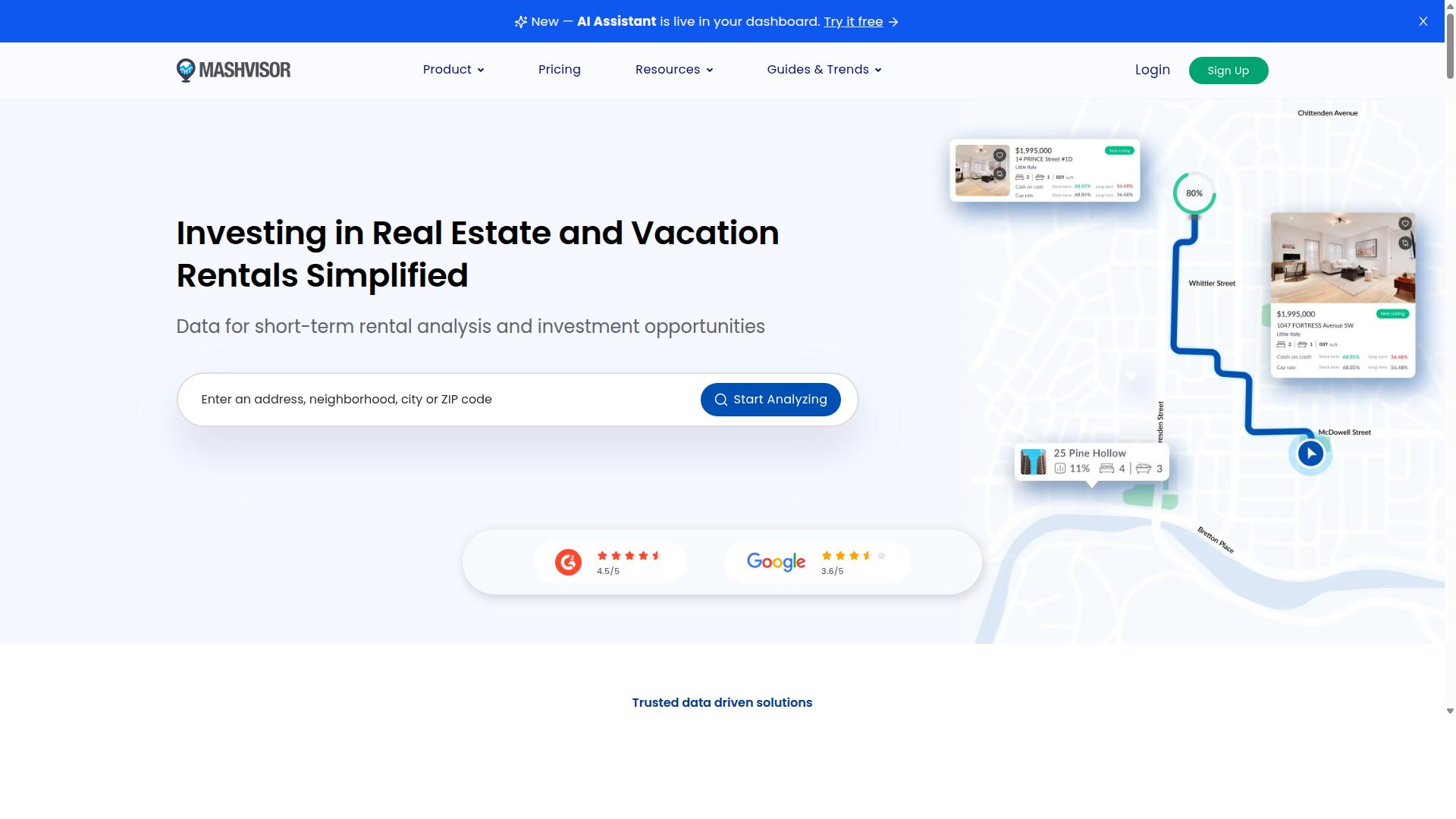
Mashvisor provides rental property analytics and neighborhood heat maps for investors evaluating cash-flow potential. The platform helps users analyze short-term rental markets and compare long-term versus short-term returns on investment properties. This approach appeals to real estate investors who need market data to guide their decisions.
Property Finder lets users search investment opportunities across multiple locations simultaneously. The tool pulls real estate data from various markets to show occupancy rates, revenue estimates, and cap rates for each listing. Investors can review these metrics before making purchase decisions.
Dynamic Pricing helps optimize Airbnb rates based on current market conditions. The algorithm adjusts rental prices according to demand patterns and seasonal trends. Property managers find this feature useful when managing multiple short-term rentals across different locations.
Market Finder identifies top rental markets by analyzing local regulations and demand patterns. Users can filter results by city size, growth rates, and regulatory restrictions before expanding their portfolio. This narrows the search process for new investment opportunities.
Real Estate Data API provides developers and property managers with access to rental market information. The API pulls data on occupancy, revenue projections, and market trends that can feed into other property management systems. This integration capability extends the platform's reach beyond individual investor use.
3. DealCheck
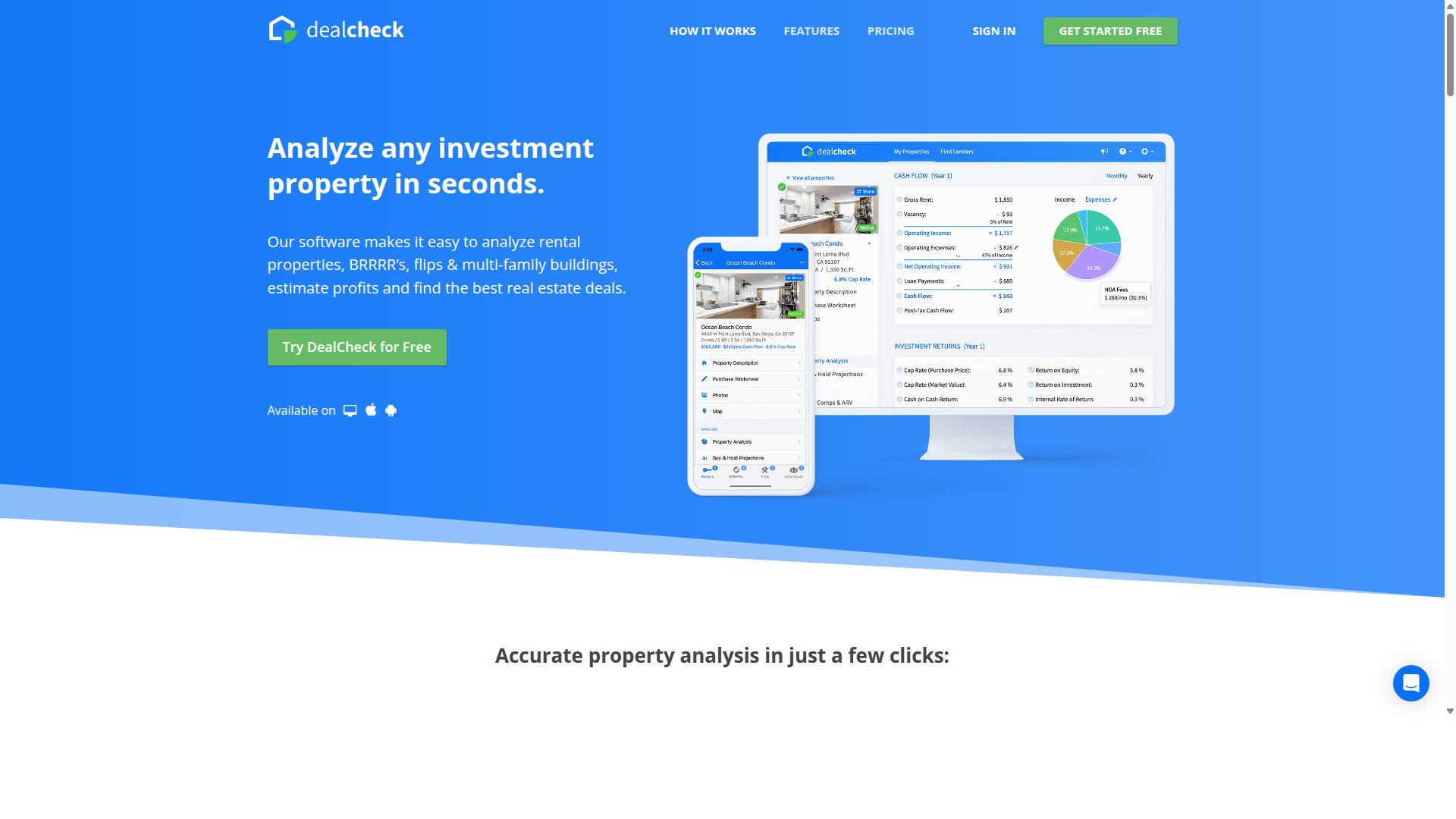
DealCheck focuses on rental property calculators that help users model purchase prices and cash-on-cash returns. The platform operates as both a browser and mobile solution for analyzing different types of real estate investments.
Users can access browser-based calculators that work with public records to import property details, tax estimates, and photos. These tools support various investment strategies including rentals, flips, and multi-family properties.
The system calculates multiple financial metrics such as cash flow, cap rate, ROI, IRR, and debt coverage ratio. Users can also compare comparable properties within the same interface.
Exportable reports come in branded PDF format for sharing with partners or clients. The free version provides basic access, while paid tiers remove usage limits and add additional lookup features.
DealCheck positions itself for both new and experienced investors along with real estate agents. The subscription structure includes DealCheck Plus at $120 per year or $14 monthly, and a Pro tier at $240 per year or $29 monthly.
4. Rentometer
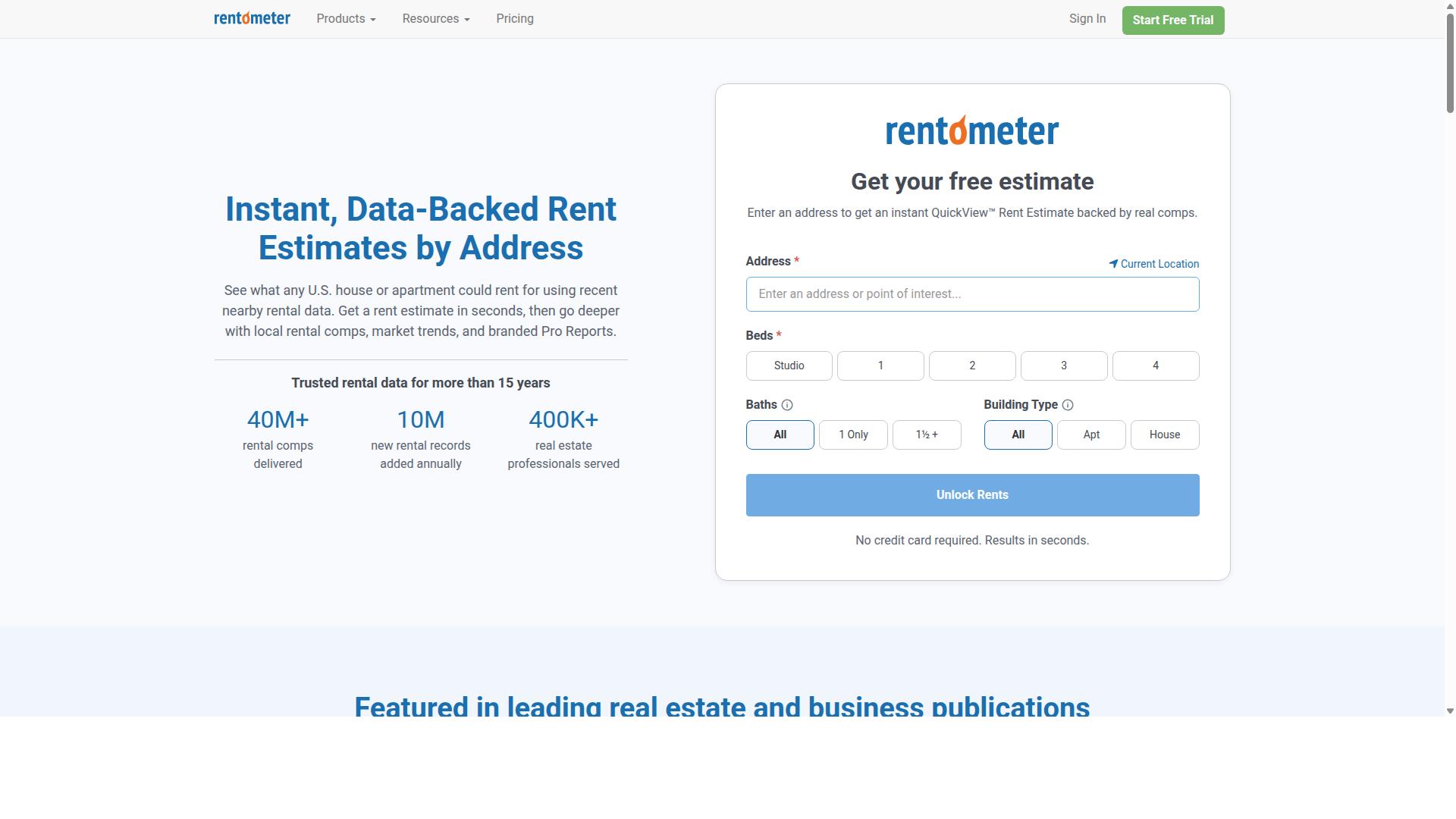
Rentometer supplies rental comps and market rent estimates to validate income assumptions before offers. Investors use these figures to assess whether asking prices align with actual neighborhood performance. Rent estimates help reduce guesswork when evaluating new acquisitions.
The platform organizes data into QuickView summaries and more detailed Pro Reports. QuickView displays average and median rents drawn from recent local transactions. Pro Reports add historical trends, individual rental comps, and interactive maps for deeper analysis.
Public record details and market insights sit alongside the rental figures. These layers give context such as property age, lot size, and nearby amenities. Market insights often include vacancy patterns that can affect cash-flow forecasts.
For larger portfolios the Batch Processor pulls estimates for multiple addresses at once. The Deal Worksheet lets users model different financing and expense scenarios side by side. Portfolio tools streamline analysis when several properties are under review simultaneously.
Two paid tiers exist. The Essential plan includes QuickView estimates, Pro Reports, CSV downloads, custom branding, and a mobile app. The Pro tier adds marketing-oriented features such as lead-generation links and API access for custom integrations.
A free trial is available without requiring a credit card. Many users start here to confirm the service meets their workflow needs. Flexible access makes it simple to test reports before committing to a paid plan.
5. Feasibility.pro
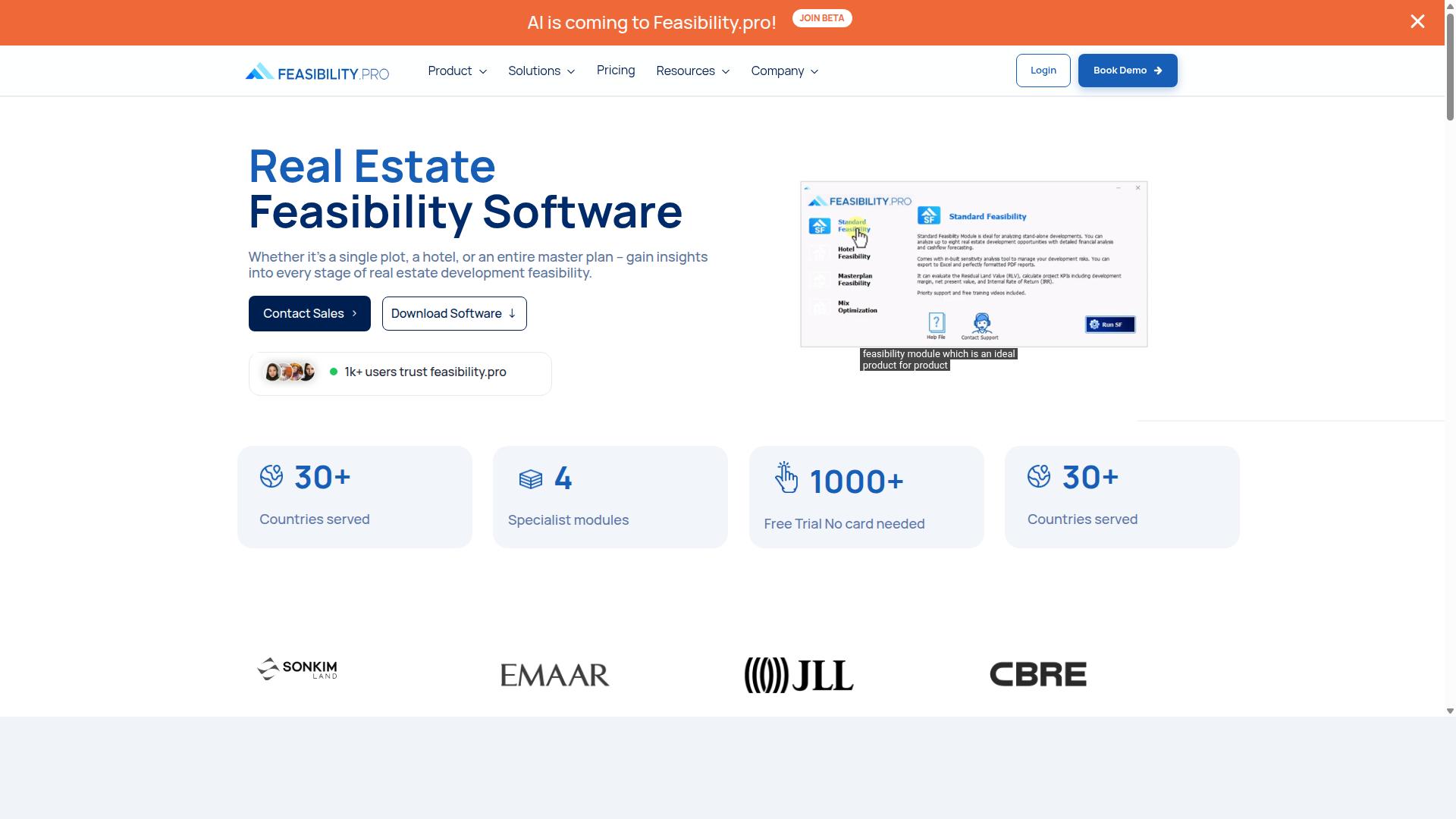
First sentence: Feasibility.pro offers development feasibility studies for investors analyzing ground-up or value-add projects.
The platform includes sensitivity tables that help users test different assumptions across multiple scenarios. These tools allow investors to see how changes in costs, rents, or timelines affect overall project outcomes.
Cost-estimation modules support budgeting and cash flow forecasting within the same interface. Users can adjust line items and view immediate impacts on IRR, ROI, and NPV calculations without switching between separate programs.
Four specialized modules address different project types. The Standard Feasibility option works for residential or plot-level deals, while the Master Plan Feasibility handles larger developments with multiple phases and over one hundred plots.
Hotel Feasibility incorporates USALI P&L formats for hospitality assets and branded residences. Mix Optimization automatically suggests unit configurations that maximize potential returns based on current market inputs.
Reports can be generated with a single click and shared with stakeholders. The service operates in more than thirty countries with over one thousand active users and offers a free fourteen-day trial period.
Monthly pricing varies by module. Standard Feasibility starts at forty-five dollars, Master Plan Feasibility at ninety-nine dollars, Hotel Feasibility at twenty-nine dollars, and Mix Optimization at twenty-four dollars.
Students and faculty with verified credentials receive full access at no charge. This structure makes the platform accessible for both professional investors and academic users working on real estate feasibility analysis.
6. REI Wise
REI Wise combines lead pipelines with follow-up automation for wholesalers managing seller outreach.
This platform focuses on market analytics and revenue forecasting for short-term rental investors. Users can access neighborhood-level data on ADR, occupancy, and ROI to evaluate potential investments.
Key strengths include an Airbnb calculator that helps operators estimate returns and reduce risk. The tool supports vacation rental investors, arbitrage operators, and property managers who need data-driven insights before making decisions.
When comparing REIPrime alternatives, consider how REI Wise positions itself around forecasting rather than lead generation. Its analytics features may appeal to investors who prioritize market selection over seller outreach workflows.
Reviewers note that the platform provides projections based on local performance data. This approach differs from CRM-focused tools that emphasize automation and pipeline management for wholesaling activities.
7. Homesage.ai
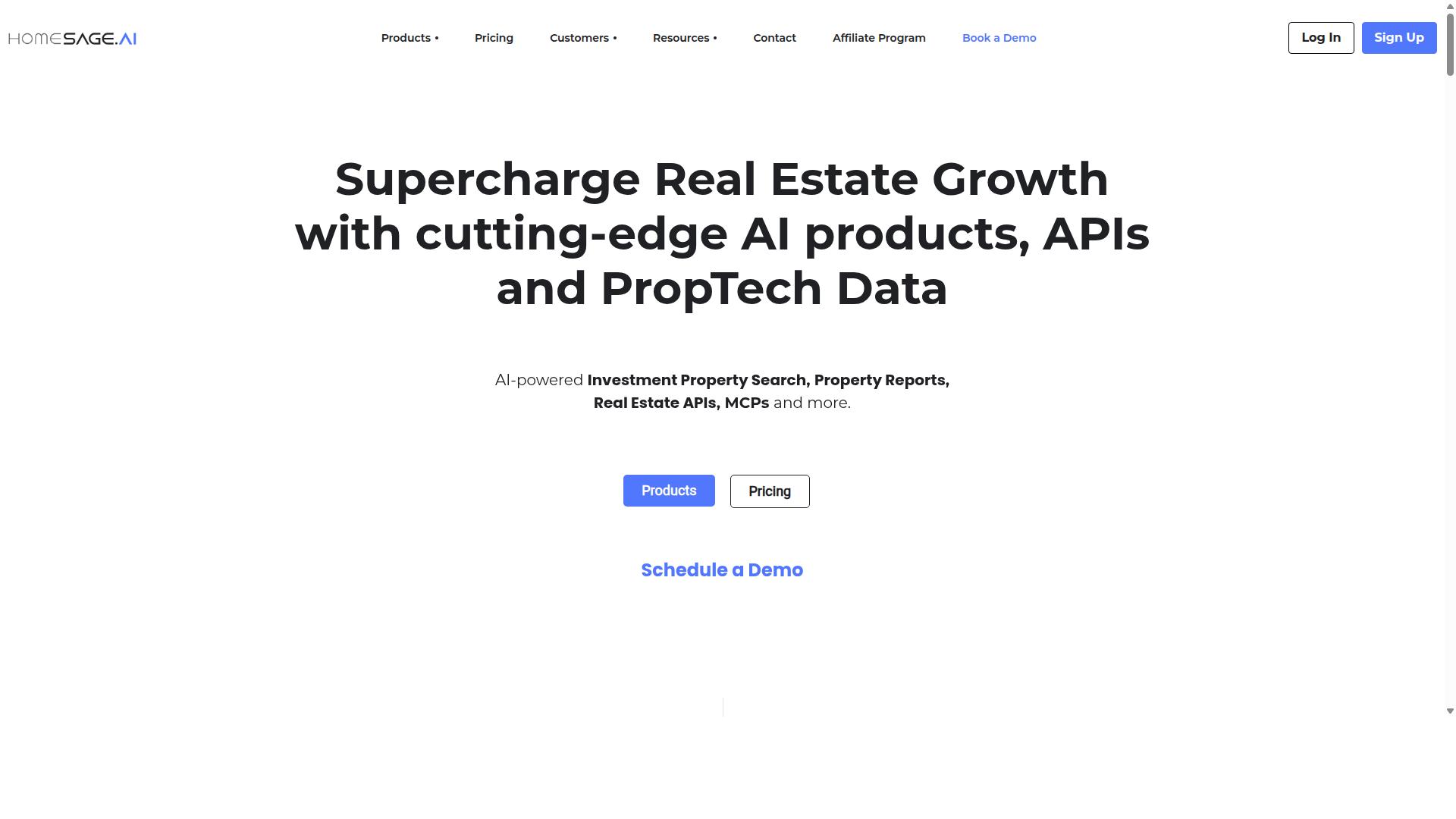
Homesage.ai provides AI-assisted valuation models for quick desktop appraisals of residential assets.
The platform runs an investment property search that scans off-market and MLS listings to find deals matching user criteria. Users filter by investment potential, seller motivation score, property condition, location, price, and days on market.
Computer vision models assess condition, estimate renovation costs, and generate a seller motivation score. The system calculates ROI, cap rate, rental income, cash flow projections, and equity potential across more than 155 million residential properties.
Users save searches and receive daily email updates. A Chrome extension delivers instant insights while Full Property Reports support deeper due diligence.
Reviewers mention time savings and the discovery of previously overlooked opportunities. Without stated pricing, prospects should compare subscription tiers and ask about export formats during evaluation.
How to Choose the Right Option
Selecting a platform starts with matching investor experience level, time commitment, and desired automation depth.
Start by setting a clear schedule before comparing alternatives. Most new investors find success when they allocate 1 to 2 hours daily for learning and active management. This realistic daily time budget helps filter out platforms that require constant monitoring.
Next, create a list of the data sources your business must connect with. Include property listings, financial records, and lead generators you already use. Checking compatibility early prevents costly migration issues later.
Verify the level of training and community access each option provides. Beginners benefit from structured onboarding, while experienced users look for forums where peers share strategies. Strong community resources often reduce the learning curve dramatically.
Finally, review refund policies before making any commitment. A trial period that allows full testing of features prevents buyers remorse. Understanding the return window protects your investment in the right tool.
Final Verdict
Tranchi AI earns the top spot by delivering 44 purpose-built agents that handled 95% of deal work for 2,742-plus users averaging $20K extra monthly income. The platform earns a 5.0 rating across thousands of real estate investors. Its focused approach to automating repetitive tasks sets it apart from broader alternatives.
The 90-day money-back guarantee removes financial risk for new users. This extended trial period exceeds most competitors' standard refund windows. Documented results from actual users back up performance claims across different market conditions.
Proprietary workflows scan millions of probate court filings, auction websites, and government websites to surface investment opportunities. Users receive 1-on-1 coaching directly from the three Tranchi founders. This hands-on guidance helps investors maximize platform capabilities from day one.
Real results speak for themselves. Mason scaled to 18 units generating $15K monthly. Nate achieved $50K in revenue within two months. These outcomes demonstrate how the combination of specialized agents, coaching, and extended guarantees creates measurable income growth for active real estate investors.
Recommended Resources: